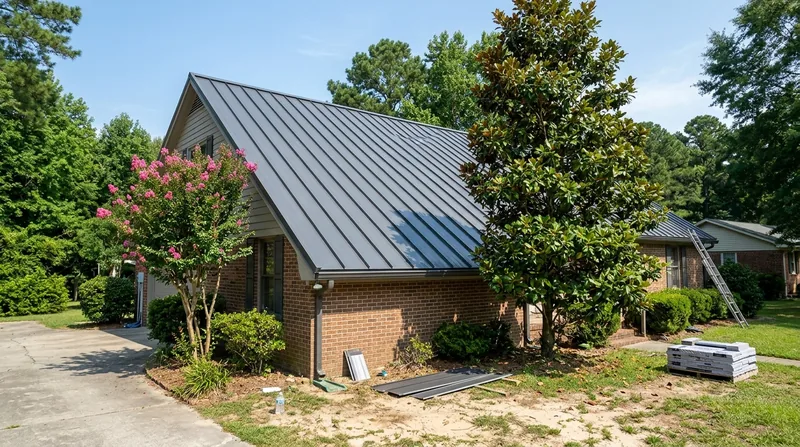




Standing seam metal roofing in Greenville is the concealed-fastener system that makes sense for a flat Tar River floodplain where summer heat and humidity work on a roof every single day. Your 1950s brick ranch in Brook Valley or your newer vinyl home in Ironwood sits under the same punishing cycle: panels expand at noon and contract at midnight, and exposed screws back out over time. Standing seam panels are roll-formed to length and locked together with a raised seam, so there are no fasteners piercing the surface. We install them on Queen Anne and Craftsman bungalows near the uptown historic district, on low-pitch ranches in Cherry Oaks and Eastwood, and on farmhouses and outbuildings out toward Grimesland and Bethel. The result is a roof that sheds tropical-storm gusts, reflects summer sun, and holds its finish through decades of Pitt County weather. If you want to compare this system against a full tear-off, start with our metal roof installation overview.
Why Standing Seam Fits Greenville Homes and the Tar River Floodplain
Greenville sits at roughly 50 feet elevation on sandy loam, surrounded by loblolly pines, live oaks, magnolias, and bald cypress. That mix drops limbs and debris on roofs every time a thunderstorm rolls through, and the humid summers feed algae and moss on asphalt shingles. Standing seam solves both problems: the smooth painted finish resists algae streaking, and the interlocking panels shed debris instead of trapping it. The concealed clips also mean no screw heads to rust or back out as the roof moves through its daily heat cycle.
- Wind resistance comes from mechanically seamed panels and concealed clips rated for high uplift pressures during tropical storms.
- Heat reflection reduces attic load during Greenville's long humid summers, when shingle roofs bake all afternoon.
- No exposed fasteners eliminates the screw-loosening failure that shows up on older exposed-fastener roofs around Ayden and Winterville.
- Panel lengths run to the ridge on most ranch and bungalow roofs, which removes end laps where water can work in.
- Long service life keeps the roof out of the replacement cycle that asphalt shingles fall into every 15 to 20 years in this climate.
On a low-slope brick ranch in Cherry Oaks, that combination often means the difference between patching a shingle roof every few years and installing a roof once.
Key info: A 1960s ranch in Eastwood with a low-pitch shingle roof is a common candidate for standing seam because shingles wear fast on low slopes. Panels handle the pitch better and shed the pine needles that pile up along the eaves.
Roofing permits are generally required for a full replacement in Greenville and Pitt County, and the local building department sets the thresholds and inspections. Verify the current requirements with the City of Greenville before work starts.
How We Install Standing Seam on a Greenville Roof
Every standing seam job starts with measuring the roof and ordering panels roll-formed to the exact length, so there are no mid-slope laps. We strip the old roofing down to the deck, replace any soft sheathing, and lay a high-temperature underlayment rated for metal. Then the panels go up, get aligned, and are seamed or snap-locked depending on the profile you choose. Trim, ridge caps, and flashing at chimneys and skylights finish the job, and we walk the roof with you before we pack up.
- We inspect the deck and framing, then replace rotten sheathing before any panel goes on.
- We install synthetic underlayment and ice-and-water shield at valleys and penetrations.
- We set the panels, align the seams, and fasten with concealed clips.
- We mechanically seam or snap-lock the panels according to the profile.
- We install ridge, hip, and eave trim plus flashing at chimneys and skylights.
- We clean the site and walk the finished roof with you.
If your home already has a sound shingle roof, ask about a retrofit instead of a tear-off. Our metal roof over shingles page explains when that route works and when it does not.
Key info: A 1920s Craftsman bungalow near the uptown historic district may need design review before a panel profile or color is approved. We check that early so the panel order does not sit in limbo.
Standing Seam Profiles and Approaches We Use
The right profile depends on your roof pitch, your budget, and how the panels will be seamed. A steep Queen Anne roof near the Tar River takes a different approach than a low-slope ranch in Biltmore. Here is how the main options compare.
| Approach | Description | Best for |
|---|---|---|
| Mechanically seamed | Panels joined with a raised double lock seamed by machine. | High-wind exposure and long panel runs on ranch and farmhouse roofs. |
| Snap-lock | Panels snap together over concealed clips without a seaming tool. | Steeper residential roofs where the seam profile is mostly visual. |
| Tear-off and new install | Old shingles removed, deck inspected, new underlayment and panels installed. | Roofs with worn or layered shingles that need deck repairs. |
| Retrofit over shingles | Panels installed over a sound existing shingle roof with a proper underlayment. | Homes where the shingle layer is sound and code allows the added layer. |
| Panel color and finish | Kynar painted finishes in a range of colors and profiles. | Historic-district and HOA homes that need an approved color. |
Color and profile choice often comes down to what the neighborhood and any design review board will accept, so we bring samples to the estimate.
Standing Seam Metal Roofing Cost in Greenville: What to Expect
Standing seam pricing starts around $10 per square foot, and that figure moves with roof complexity, panel profile, and whether we tear off the old roof or retrofit over it. A simple gable ranch in Winterville sits near the low end. A cut-up Queen Anne with dormers, valleys, and a chimney near the uptown historic district sits higher because every penetration takes extra flashing and labor. Two-story access and steep pitches also add cost.
We give you a written scope that separates tear-off, deck repair, panels, trim, and flashing, so you can see where the money goes. Getting two or three estimates is smart, and comparing scope line by line matters more than comparing the bottom number. A quote that skips underlayment or flashing is not the same job. Our pricing overview breaks down the ranges in more detail.
Key info: A 1,800 square foot ranch in Red Banks with a simple gable typically lands near the starting rate, while a two-story home in Ironwood with multiple valleys and a chimney runs higher because of flashing and access work.
Standing Seam Metal Roofing Near Me: How to Choose a Contractor Near Greenville
Hiring a metal roofing contractor near Greenville comes down to paperwork, references, and straight answers. Ask for the license and insurance certificate, then call the number on it. Ask for recent local references, ideally on homes with similar roof shapes and pitches. Ask who pulls the permit and who handles historic district or HOA design review if your home falls under one.
- Confirm the contractor is licensed and insured and can show a certificate before work begins.
- Get two or three written estimates with itemized scope, not just a lump sum.
- Ask for references on standing seam jobs in Greenville, Winterville, or Ayden and call them.
- Ask who pulls the roofing permit and whether historic district or HOA approval is needed.
- Make sure the contract states panel profile, color, underlayment, and flashing details.
A contractor who answers those questions without hedging is the one you want on your roof. Reach us through the contact page to set up a free estimate.
Standing Seam Metal Roofing in Greenville: Pricing Guide
| Service | Price | Details |
|---|---|---|
| Standing seam install, simple gable | Starting at $10/sq ft | Includes tear-off, underlayment, panels, and standard trim on a straightforward roof. |
| Standing seam install, complex roof | Starting at $14/sq ft | Covers dormers, valleys, and chimneys that add flashing and labor time. |
| Retrofit over existing shingles | On estimate | Depends on shingle condition, deck soundness, and local code limits on layers. |
| Panel color or profile upgrade | On estimate | Premium finishes and custom profiles priced per panel and color selection. |
| Travel | Included | In Greenville and surrounding areas, no separate call-out or mileage fee. |
| Estimate | Free | Response within 24h at (252) 351-2955, no obligation to book. |
Indicative pricing, the exact cost depends on square footage, finish, and site access. Free personalized estimate within 24h at (252) 351-2955.


